REGISTRATION CLOSED
The recent EOI for Supplier Registration was closed on the 8th of May 2025 at 5pm.
Privacy Policy | Terms of Us
REGISTRATION CLOSED
The recent EOI for Supplier Registration was closed on the 8th of May 2025 at 5pm.
Privacy Policy | Terms of Us
April 23, 2026
So, what is EIMC?
In recent months, the Education Infrastructure and Management Company (EIMC) has moved into the center of Botswana’s national conversation on education reform. Its name appears in discussions and public debate. But for many, the question remains: what exactly is EIMC, and why does it matter?
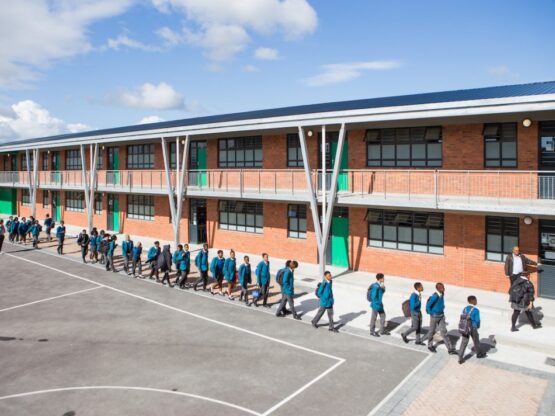
In recent months, the Education Infrastructure and Management Company (EIMC) has moved into the center of Botswana’s national conversation on education reform. Its name appears in discussions and public debate. But, what exactly is EIMC, and why does it matter? At its core, EIMC is a purpose-built, Special Purpose Vehicle created to transform how Botswana plans, delivers, and maintains public school infrastructure. It was established to address a long-standing gap between national education ambitions and the actual condition of the environments where learning takes place. Across Botswana, different parts of the system have long contributed to building and maintaining school infrastructure, each playing an important role at different stages. As needs have grown and evolved, it has become increasingly important to bring these efforts together in a more coordinated and forward-looking way. EIMC is designed to do exactly that. By taking an end-to-end view of infrastructure, from planning and design to construction, rehabilitation, maintenance, and long-term life-cycle management, it helps connect what has often been handled separately. The aim is not to replace existing efforts, but to align them into a more seamless and efficient system. This approach reflects a simple shift in thinking: infrastructure is not a once-off activity, but an ongoing cycle that benefits from continuity, coordination, and long-term planning. The creation of EIMC follows a Cabinet decision to establish a dedicated special purpose vehicle, to take full responsibility for improving public school infrastructure and how its upkeep is managed. This mandate was reaffirmed through a Presidential Directive without modification, signaling strong political will and a clear national intent. In practical terms, EIMC is expected to refurbish aging schools, expand infrastructure where there are gaps, introduce digital systems, modernise learning environments, and improve how facilities are managed over time. It is also fully government-owned, reflecting the public nature of its mission. How EIMC is structured is central to how it operates. It is set up as a Special Purpose Vehicle (SPV), a company created for a specific, focused mandate rather than as a permanent, broad-function institution. This distinguishes it from traditional state-owned enterprises such as Botswana Power Corporation or Water Utilities Corporation, which are established through legislation, deliver ongoing public services, and often own the infrastructure they operate. EIMC does not follow that model. It does not own schools, run the education system, or exercise independent authority over public education. Instead, it operates through government direction and formal agreements, focusing on delivery and management rather than control. One of the most common questions raised is whether EIMC duplicates work already being done elsewhere in government. It does not. EIMC functions as a lean coordinating agency, designed to bring together efforts that have historically been fragmented. The public school infrastructure ecosystem spans several ministries, including the Ministry of Basic Education and Child Welfare, the Ministry of Local Government and Traditional Affairs and its councils, and—given the nature of its work—other stakeholders such as the Ministry of Transport and Infrastructure, Ministry of Communication and Innovation, and the Ministry of Sports and Arts. For example, when considering school infrastructure, components such as sports facilities, the digitalisation and connectivity of schools are an important part of the overall ecosystem. EIMC’s role is to align these moving parts into a more cohesive, agile, and efficient system. Importantly, EIMC does not replace existing programmes; it works alongside them. Initiatives such as the Ikageng Public Works Programme (IPWP), which focuses on skills development and training linked to production, are complementary to EIMC’s mandate. The intention is to collaborate strategically with all actors involved in school infrastructure, rather than replicate their work. EIMC is designed to operate with a level of agility that traditional structures often struggle to achieve. By working through partnerships, clear mandates, and defined outcomes, it can move more quickly on infrastructure delivery while maintaining accountability. There is also a built-in urgency. With a defined national assignment and a limited timeframe of 36 months, EIMC is expected to deliver at pace. This means building systems while simultaneously implementing them, balancing speed with the need for quality, coordination, and impact. EIMC’s financing strategy is anchored in a mixed funding model designed to ensure both stability and long-term scalability. In its early and developmental phases, funding is primarily drawn from government development allocations. This is complemented by foundation and grant funding, as well as bilateral donor partnerships, which provide targeted development assistance aligned with national priorities. Development finance institutions and bilateral embassies also contribute catalytic funding to support infrastructure delivery, long-term investment, and broader systemic reform. Private sector contributions and donations further support specific initiatives, helping to accelerate early-stage delivery and drive innovation. As the organisation matures and demonstrates delivery capacity and measurable impact, the model is expected to gradually shift toward greater financial sustainability. This will include access to capital markets, enabling the mobilisation of private capital for expansion, innovation, and large-scale programme rollout. EIMC’s role sits at the intersection of key national priorities: improving education quality, strengthening public service delivery, expanding economic participation, and advancing social equity. Infrastructure is not separate from education outcomes. The condition of classrooms shapes how students learn, how teachers perform, and how communities experience public education. A well-maintained school enables dignity and performance; a neglected one undermines both. If EIMC delivers on its initial 36-month SPV mandate, the results will be both visible and systemic. Schools will be safer, more modern, and better equipped. Infrastructure projects will be delivered more efficiently, and maintenance will become more proactive. There will also be greater opportunities for citizen-owned businesses, SMMEs, local artisans, to participate in national development. Less visibly, these improvements are likely to strengthen learner morale, support teacher retention, and build overall public confidence in the education system. EIMC moves away from viewing infrastructure as a once-off investment, toward understanding it as a continuous system that underpins national development. In that sense, EIMC is more than a delivery mechanism, it is an instrument of reform. And its success will depend not just on what it was created to do, but on how effectively it delivers. Ultimately, EIMC represents a shift in mindset. For more information contact: Ms. Keolebogile Lebo Diswai Executive Head – Stakeholder Management & Partnerships Education Infrastructure and Management CompanySo, what is EIMC?
Strengthening a Coordinated System
What Government Approved
Why Structure Matters: Not a Parastatal
Coordination, Not Duplication
A Faster, More Flexible Delivery Model
Financing the Model: A Blended Approach
Why It Matters
What Success Looks Like
The Bigger Shift
© 2026 Education Infrastructure and Management Company (Pty) Ltd. All rights reserved.